Group theory explained: Évariste Galois and the language of symmetry
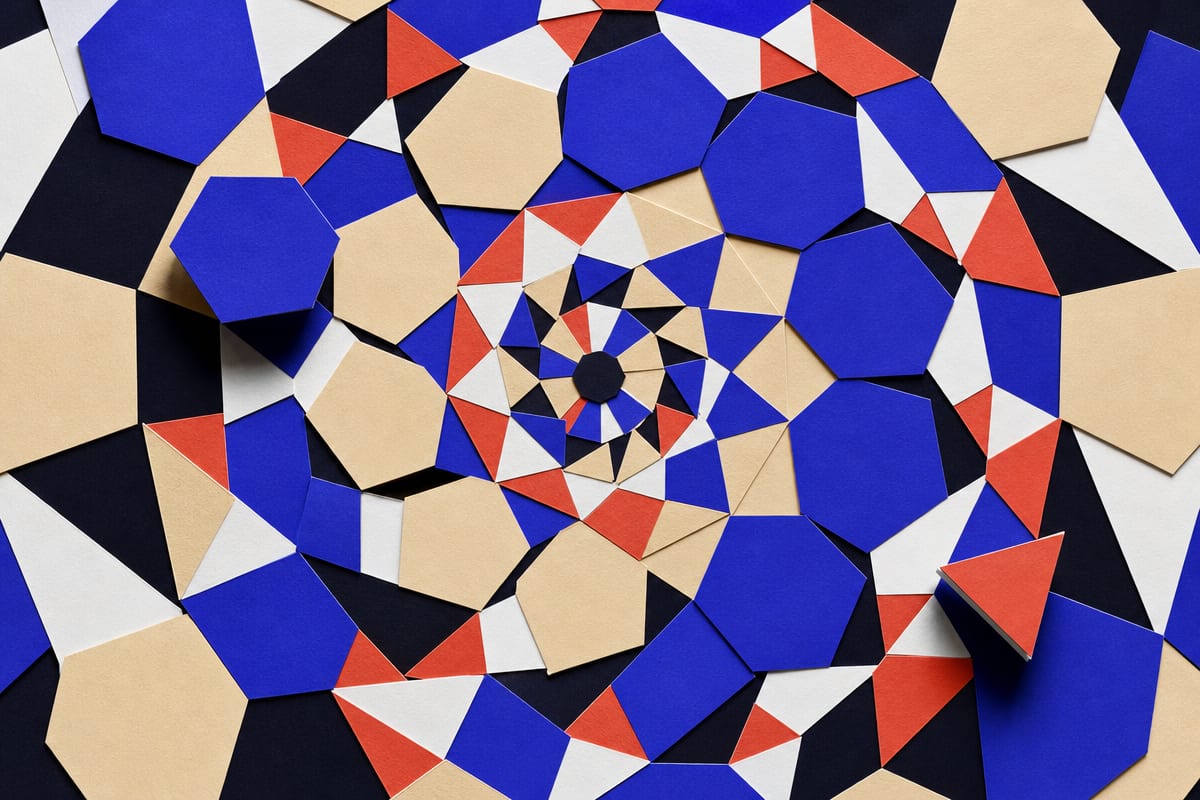
The subject of this page is the argument of The Equation That Couldn’t Be Solved, published in 2005: that group theory is the language of symmetry. Symmetry, on this reading, is not a decorative property of objects but a language with a grammar — and the claim sounds like an overstatement until you notice how much of physics is now written in it.
Group theory explained: what a group actually is
Start with an object and ask what you can do to it without changing how it looks. A square can be turned by ninety degrees, or reflected across either diagonal, or across either midline, and it comes back looking the same. Collect all eight of those moves and the collection has a structure of its own: any two combine to give a third that is also in the collection, every move can be undone by another, and leaving the square alone counts as a move. That is a group. Group theory studies the collection, not the square.
The step that takes some getting used to is the one where the object drops out. Once you have the collection of moves, the square is no longer needed — and it turns out that quite different objects can have identical collections. When that happens, anything the grammar says about one is true of the other, which is the whole reason the abstraction pays.
Who solved the cubic: the three centuries before Galois
The question Galois answered has a long and badly behaved prehistory, and it begins with a man who never published his result. Scipione dal Ferro — written del Ferro in most modern sources — held a chair at Bologna and, at some point before his death in 1526, became the first person to solve the cubic equation in the general case. He told almost nobody. Mathematical posts in sixteenth-century Italy were defended in public problem-solving contests, which made a method no rival possessed a professional asset, so dal Ferro kept his to himself and passed it near the end of his life to his son-in-law Annibale della Nave and to a student, Antonio Maria Fior.
Fior was not the mathematician his teacher had been. When Niccolò Tartaglia let it be known that he could also solve cubics, Fior challenged him in 1535 to exactly such a contest — thirty problems each. Tartaglia solved all thirty. Fior solved none of them.
That result brought in Gerolamo Cardano, who wanted the method and spent four years persuading Tartaglia to part with it. Tartaglia gave it up in 1539, encoded as a poem, and only after Cardano had sworn never to publish it. Cardano then reached della Nave and saw dal Ferro's own manuscript, which predated Tartaglia's work by more than a decade. Taking the oath to be void because the priority had never been Tartaglia's to protect, he published the solution in Ars Magna in 1545 — crediting dal Ferro with the cubic and Tartaglia with having found it again independently.
Tartaglia's reply, Quesiti et inventioni diverse, accused Cardano of perjury in the plainest available language. Cardano's student Lodovico Ferrari, who had by then solved the quartic, answered on his mentor's behalf; the two traded printed challenges for two years before meeting in Milan in 1548, where Tartaglia came off badly enough to leave the city. Ferrari died in 1565, by the traditional account poisoned by his sister.
The episode matters here because it sets the shape of the problem Galois inherited. The cubic fell in the 1520s and the quartic within twenty years of it, each by a fresh feat of ingenuity — and then nothing moved for nearly three centuries. On that record the quintic's resistance looked like a gap waiting for a cleverer man, and the reason it was not is the subject of everything below.
Galois and group theory: the problem that produced it
None of this was invented to describe symmetry. Galois and group theory arrive out of an algebra problem that had been open since the Renaissance: whether there is a formula, built from the coefficients using only arithmetic and roots, that solves any equation of the fifth degree. There is one for the quadratic, which every schoolchild learns, and there are messier ones for the cubic and the quartic. For three centuries the quintic refused.
Niels Henrik Abel showed in the 1820s that no such formula exists. Galois explained why. His move was to stop looking at the equation and look instead at the symmetries among its solutions — which permutations of the roots leave the relationships between them intact. Those permutations form a group, and whether a formula in radicals exists depends on whether that group can be broken down in a particular stepwise way. For the general quintic it cannot. The impossibility is a structural fact, not a failure of ingenuity.
He wrote this down as a very young man, submitted it to the Académie, and had it lost twice and rejected once. He died in a duel in 1832 at the age of twenty, having spent the previous night writing out his results. They were not properly understood for another fourteen years.
The pairing of Galois and group theory is therefore slightly misleading as a piece of shorthand. He did not set out to build a theory of symmetry; he built the tool an algebra question demanded, and the theory of symmetry is what the tool turned out to be. Explained in that order, the history makes more sense than the tidier version.
The language of symmetry, from crystals to particle physics
What makes the language of symmetry more than a metaphor is that the same groups keep turning up in unrelated places. There are exactly 230 ways to arrange a repeating pattern in three dimensions, and crystallography is in large part the business of working out which of the 230 a given crystal uses. The classification is a result in group theory and it constrains what matter can do.
Particle physics went further and made the groups primary. The strong, weak and electromagnetic interactions are each specified by a symmetry group, and the particles are classified by how they transform under it. Predicting a particle before it is found — which has happened repeatedly — amounts to noticing a gap in a pattern the group requires to be complete. Music is the gentlest example: transposing a melody and inverting it are group operations, and composers were using the structure long before it was named.
Why symmetry needed a grammar, explained through one equation
The reason the book takes the quintic as its route in is that the quintic is where symmetry stopped being descriptive and became load-bearing. Before Galois, saying an object was symmetric was an observation. After him, the symmetries were an object in their own right, with properties that could settle questions nothing else could settle — including a question about algebra that had nothing obviously to do with symmetry at all.
That is the sense in which group theory is the language of symmetry and not a description of it. A description can be paraphrased. A grammar generates statements you could not have made otherwise, and the classification of crystals and the prediction of particles are both statements of that kind.
Questions
What is group theory, in plain terms?
The study of what stays the same when something is changed. Collect every transformation that leaves an object looking identical — rotations of a snowflake, say — and that collection has a structure: transformations combine, each can be undone, and doing nothing counts. Group theory studies that structure rather than the object.
Why can the general quintic not be solved?
Not because nobody has found the formula. Galois showed that the symmetries of a general fifth-degree equation’s solutions form a group with a structure that cannot be taken apart in the way a formula in radicals would require. The impossibility is a fact about the group, which is why the proof needed group theory to exist first.
Who was Évariste Galois?
A French mathematician who died in a duel in 1832, aged twenty. He had by then written down the correspondence between field extensions and groups of symmetries that carries his name, in work that was rejected or lost by the mathematicians he sent it to and only understood more than a decade after his death.
Where does group theory show up outside mathematics?
In crystallography, where the possible symmetries of a crystal lattice are a finite classified list; in particle physics, where the fundamental forces are described by specific symmetry groups; and in music theory, where transposition and inversion are group operations. It is the same machinery in each case.
Does understanding this require the mathematics?
No. What a group is can be stated in a sentence and the reason the quintic resists can be described without notation, which is what The Equation That Couldn’t Be Solved does at book length.